On the 27th of March 2025, the United Nations held a high level event at the General Assembly Hall in New York dedicated entirely to waste in the fashion and textiles industry. Governments, environmental bodies and policy makers sat in one of the most recognisable rooms in the world and acknowledged what the rest of us have known for years. The fashion industry is producing too much, too fast, and the planet is absorbing every consequence of that decision while the people running the machine continue to post record profits.
That meeting did not make global headlines the way a celebrity wedding does. And that silence is part of the problem.
Fashion was not always this. A traditional fashion house once spent six months to a full year producing a single collection, from the first sketch to the moment a garment reached a store floor. The process involved designers, pattern cutters, fabric specialists and quality assessors whose entire job was to ensure that what left the workshop was built to last. Clothes were made with the understanding that they would be worn repeatedly, passed down, altered, repaired. A coat was an investment. A dress was a decision.
Then the model shifted. Zara compressed that six month cycle to five weeks and the industry celebrated it as innovation. What it actually was, was the first crack in a wall that would eventually come down completely. Because behind Zara came Shein, and Shein turned five weeks into seven days. Today, Shein designs, produces and releases a finished garment in as little as three to seven days. It adds over three thousand new styles to its platform daily. In a single year, it launched 1.5 million new products. Zara, considered fast before Shein existed, managed 40,000 in the same period.
The clothes produced at that speed are not made to be worn for years. They are made to be photographed once, posted, and forgotten. The fabric is thin enough to see through under studio lighting. The stitching loosens after two washes. The colour fades before the season ends. This is not a side effect of the business model. It is the business model. A garment that falls apart quickly is a garment that needs to be replaced quickly, and replacement is what keeps the revenue growing. Quality is not a failure of fast fashion. Disposability is the product.
What built this market to its current scale is not manufacturing alone. It is the internet, and more specifically, the architecture of attention that the internet created. Social media platforms did not just give brands a new place to advertise. They created an entirely new class of salesperson: the influencer. Ordinary people with cameras, charisma and a gift for making consumption look like a personality became the most effective marketing infrastructure the fashion industry had ever had access to. A haul video on TikTok, in which someone unboxes seventy items of clothing bought for the price of a restaurant meal, reaches millions of people who are not watching an advertisement. They are watching a friend, or someone who feels like one.
The influencer does not sell the dress. The influencer sells the feeling of the dress, the lifestyle of the dress, the version of yourself that owns the dress. And because the dress costs four dollars and the influencer has a discount code, the barrier between wanting and buying collapses entirely. Research has found that millennials readily admitted to purchasing items promoted by influencers, and that the shift in authority over what people wear has moved entirely from magazine editors and runway shows to get ready with me videos filmed in a bedroom at midnight. Fast fashion did not create this culture. Fast fashion and influencer culture created each other, and together they created something the planet was not designed to absorb.
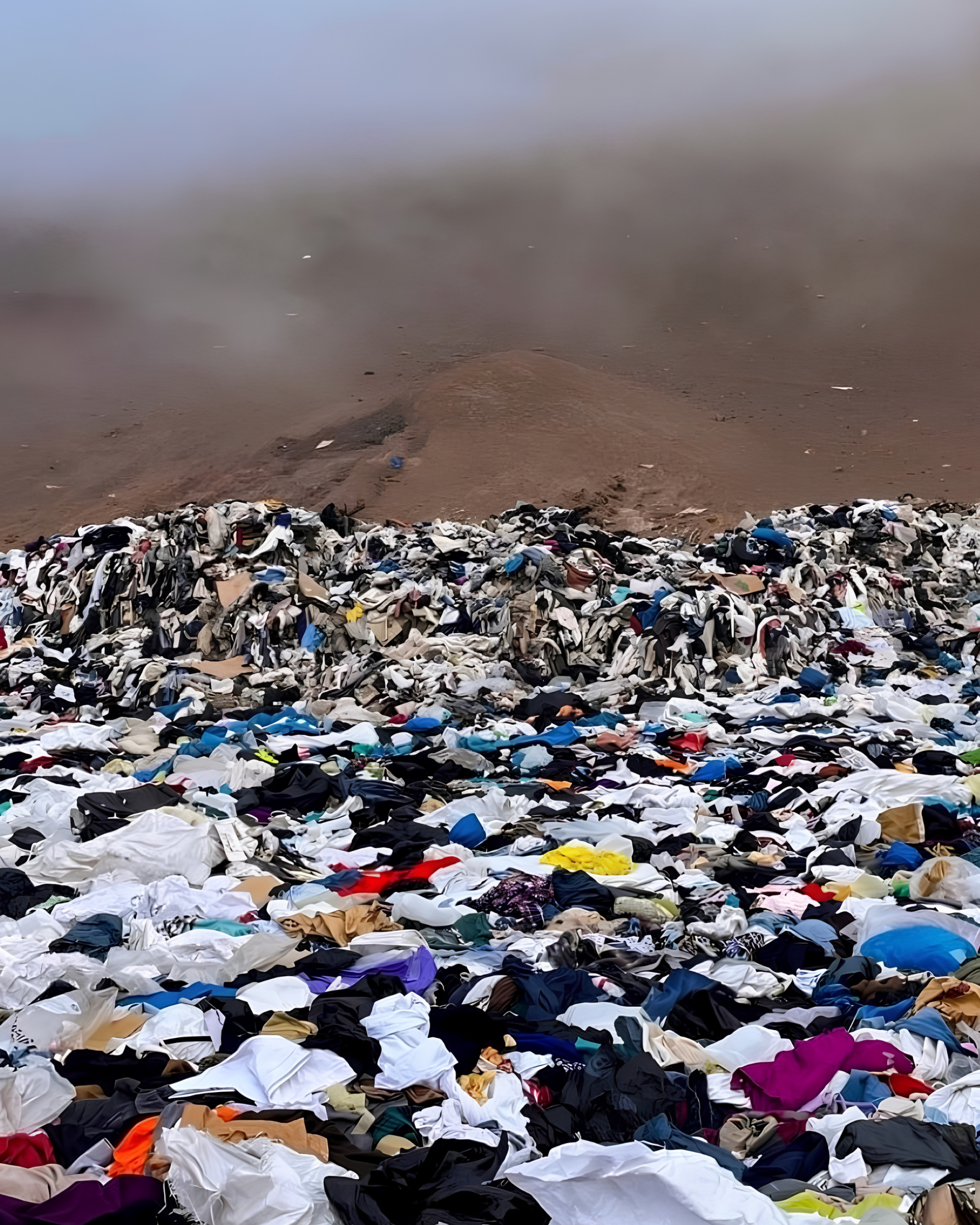
The environmental consequences are no longer theoretical. The fashion industry generates 92 million tonnes of textile waste every year globally, a figure expected to climb to 134 million tonnes by 2030. It is responsible for 10% of global carbon emissions, a figure that surpasses the combined output of all international flights and maritime shipping in the world. Producing a single cotton shirt consumes 2,700 litres of water, approximately the amount a person drinks across three years. The synthetic fibres shed from cheap polyester garments enter waterways and oceans as microplastics, accumulating in fish, in soil, in the bodies of insects whose role in sustaining life on earth cannot be overstated. None of this is accidental. All of it is the direct consequence of a system producing more than the earth can process, at a speed the earth was never consulted about.
Governments are now attempting to respond. France passed legislation in June 2025 imposing a progressive eco-tax starting at five euros per item for ultra-fast fashion brands, rising to ten euros by 2030, alongside a full advertising ban and financial penalties for influencers who promote these brands. The EU introduced a law taking effect in July 2026 banning the destruction of unsold clothing through incineration or landfill. The United States, Indonesia, South Africa, Argentina, Brazil and Mexico have each moved to close the import loopholes that allowed billions of unregulated cheap parcels to enter their markets tax-free every year.
These are not small gestures. But they are also not enough. The French law that positions itself as a landmark against ultra-fast fashion specifically protects European players like Zara and H&M from its harshest penalties. The eco-tax does not make a four dollar dress unaffordable. It makes it an eight dollar dress, which is still cheap enough to buy on impulse and discard without a second thought. The advertising ban addresses the influencer while the algorithm that does the same promotional work for free continues operating without any regulation at all.
The deeper question is one that no law passed so far has been willing to answer directly. Can an industry built on the logic of infinite growth produce less? Can a business model whose foundation is manufacturing desire be trusted to suppress that desire voluntarily? The history of fast fashion suggests the answer is no. Every sustainability pledge issued by a major fast fashion brand has been followed by record production numbers. Every apology for labour conditions has been followed by a subsequent investigation finding those conditions unchanged. The gap between what these companies say and what they produce is not a communication problem. It is a structural one.
What the future of fast fashion actually looks like may come down to a question that is bigger than fashion. The earth that absorbs the dye, the water, the carbon and the waste from an industry producing for a world of eight billion consumers did not vote for this arrangement. The insects losing habitat to cotton fields treated with pesticides did not file a comment during the consultation period. The fish accumulating microplastic in their tissue were not in the room in New York on the 27th of March 2025.
The question is not whether fast fashion will face consequences. It already is. The question is who the consequences fall on, and whether the people with the power to change the system will do so before the people without any power at all run out of time.