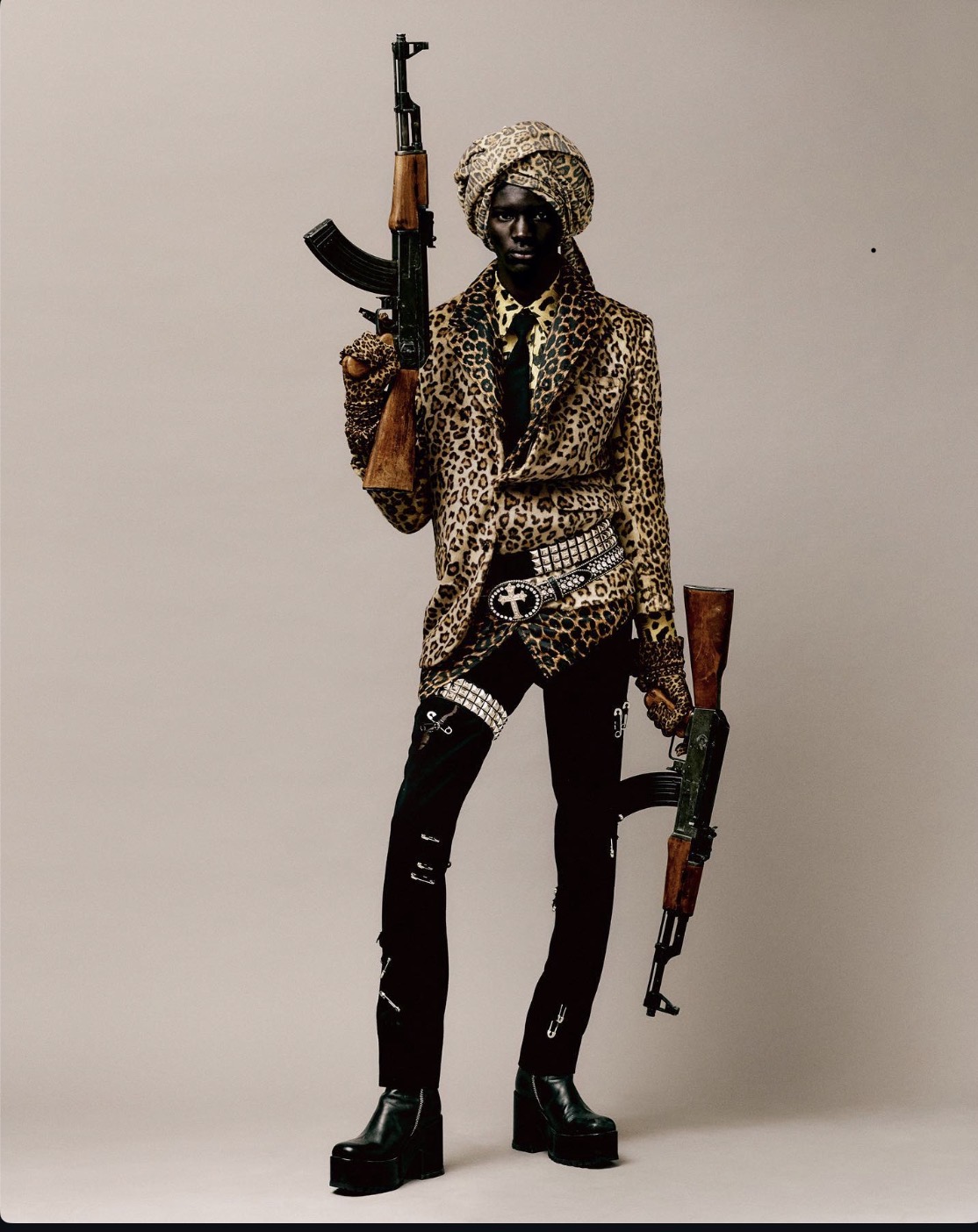
On the 12th of February 1947, Christian Dior walked out of a salon in Paris and presented a collection that used up to 80 yards of fabric in a single dress. Europe was still rationing food. Entire cities were still rebuilding from rubble. Women who had spent years in boxy, utilitarian clothing, shortened skirts and padded shoulders engineered for practicality and fabric conservation, were confronted with something that looked, by any measure of the moment, obscene in its abundance. For many Europeans still living with the privation of postwar food, energy and fabric rationing, Dior’s styles read as offensively wasteful.
At a photoshoot in Montmartre, Dior’s models wearing his new designs were attacked by Parisians. Many in France were still recovering from the war, and to see such extravagant clothing being paraded around in public felt deeply wrong. Women from the Little-Below-the-Knee Club staged protests in Chicago. A group of men in Georgia collected signatures calling for a ban. The garments were not just clothes. They were a provocation, a political statement made in fabric, a declaration that the war was over and abundance was returning, issued to a population that was still living inside the wound.
This is what conflict does to clothing. It makes it mean something it was not designed to carry.
During the Second World War, fabric rationing and a focus on utility had led to clothing styles that were simple, straight-lined, and often androgynous. Skirts were shorter, and waistlines were often eliminated altogether, reflecting the need for women to be practical and resourceful during difficult times. Fashion did not disappear during the war. It contracted. It became a document of scarcity, a record of what was available and what was demanded of the people wearing it. The silhouette of wartime Britain is not a fashion choice. It is a piece of social history pressed into cloth.
Then the war ended, and Dior gave women back their waists and their volume and their length, and half the world called it liberation and the other half called it waste. Both were right. After the rationing of fabric during the Second World War, Dior’s lavish use of material was a bold and shocking stroke. After the war, women longed for frivolity in dress and desired feminine clothes that did not look like a civilian version of a military uniform. That longing was real. The hunger for beauty after years of austerity is a documented human response to surviving something that was trying to kill you. Dior read it and answered it and became one of the most famous designers in history for doing so. He also did it while much of Europe was still too poor to eat properly. That tension has never been resolved. It simply got buried under decades of celebrating the collection.
But the story of fashion after the Second World War did not end with Dior. What the war actually produced, in ways that took a decade to fully emerge, was something the fashion industry had never had to reckon with before: the teenager.
A wartime increase in births and a postwar baby boom saw the American teen population grow from 10 million to 15 million during the 1950s, eventually hitting a peak of 20 million by 1970. Peacetime saw a decline in full-time youth employment, but a rise in youth spending was sustained by a combination of part-time work and parental allowances, with teenage Americans’ average weekly income rising from just over two dollars in 1944 to around ten dollars by 1958. A generation that had grown up watching their parents survive deprivation, rationing and loss now had money in their pockets and no war to justify spending it carefully. They spent it on themselves. They spent it on music, on clothes, on the first credible youth culture the modern world had seen.
By the mid-1950s, a growing movement away from the conformity and regularity of adult culture developed in both Europe and the United States. Teenagers began to reject the values and conventions of their parents. They listened to a new form of music called rock and roll, and they adopted new rebellious clothing styles. By the late 1950s the Western world saw the emergence of a definable youth movement, and in the 1960s that movement would begin to dominate fashion. The gray flannel suit that had dressed a generation of postwar businessmen was being discarded by their children in favour of denim, leather, oversized zoot suits and everything else the adult world had decided was inappropriate. In England, the emerging generation was bored of the couture houses’ conservative designs and instead looked to boutiques to reinvent their style. This was a time when teenagers were able to explore their own identities and had the freedom to push boundaries due to postwar conditions.
War had created the conditions for the most significant shift in the history of fashion as a mass phenomenon. The austerity of the conflict years produced a generation hungry for excess. The discipline demanded of wartime society produced children who, once grown, had no appetite for discipline at all. The conservative silhouettes of the postwar recovery years produced a youth movement that tore them apart entirely. Fashion did not just change after the Second World War. It became something it had never been before: a language young people used to separate themselves from the generation that had survived the bombs, and to build something entirely their own.
Americans purchased televisions, automobiles, homes and clothes in record numbers after the war. They were encouraged by an advertising industry that developed a range of ways to convince people to buy their products. Consumerism as we understand it today was born in the space the war left behind. The infrastructure of modern fashion, the idea that clothing could be produced in volume, marketed aggressively, sold to a mass market, and replaced seasonally, was not built on creativity. It was built on the economic conditions that the Second World War created when it ended. The industry that now produces 92 million tonnes of textile waste a year was assembled in the years of postwar abundance, and it has been running at full speed ever since.
What happened in Ukraine on the 24th of February 2022 belongs to the same conversation, and it is a very different one.
On the morning of that day, Ukrainians woke up to the sounds of explosions. From that moment it felt like time had stopped. After a while, they realised that life had to continue despite the deadly attacks and the constant blaring of air alerts. Businesses had to resume work so that people could feed their families and donate to the Ukrainian army. Fashion, like other fields, had to adjust to the reality of war.
A designer’s team resumed production on a delayed spring collection. Dresses were sewn to the constant sounds of air raid alerts. The designer described it as deeply symbolic: each item filled with the spirit of freedom and the strength of the Ukrainian people. Ksenia Schnaider and her team of seamstresses toiled away in their Kyiv studio, crafting a new collection of designer denim and luxury daywear even as air raid sirens, drone attacks and power cuts took over their lives and made production almost impossible to continue. These were not acts of vanity. They were acts of resistance. The insistence on making beautiful things in a city being bombed is a political statement as powerful as any protest placard. It says the culture will not be destroyed. It says we are still here and we are still ourselves.
When Ukrainian Fashion Week returned to Kyiv for the first time since the full-scale invasion, war veterans, men and women, walked the runway with prosthetic limbs. A designer said they wanted to show that Ukrainian fashion was adapting to society, for people with amputations who survived the war, and that people are unbreakable. Without limbs, they can be stylish. They need to be loved, respected and perceived as an integral part of society. One standout piece was a black jacket embroidered with the image of the Mariupol drama theatre, where a large number of civilians were killed in a Russian airstrike while sheltering inside. That jacket is not fashion in the way the industry uses the word. It is a memorial sewn into a garment. It is grief made wearable. It is the kind of thing that makes every conversation about trend cycles and seasonal collections feel like it is happening on a different planet.
Meanwhile, tanks began rolling across Ukraine’s borders during Milan Fashion Week, with bombing intensifying through the Paris shows, leading to some uneasiness about the frivolity of the proceedings. Giorgio Armani paraded his fall 2022 collection without music, while French fashion’s organising body urged everyone to witness the shows with solemnity. There was not enough time to change collections, some of which included olive drab, bomber jackets and body armour reminiscent of flak jackets. It was quite painful to witness some brands’ clumsy attempts to either ignore the war or to align their collections meaningfully. The fashion industry, confronted with a live war playing out on the same days as its most important commercial events, had two choices. It could reckon with the weight of what was happening or it could keep going and feel awkward about it. Mostly it kept going and felt awkward about it.
This is the industry’s consistent response to crisis. A brief moment of visible discomfort, a charity fundraiser, a social media statement, and then the shows continue. The collections ship. The reviews are published. The machine moves forward because the machine is built to move forward and stopping it, even for a moment of genuine collective reckoning, would cost money that nobody in the boardroom is prepared to lose.
The people who do not have that option are the ones who leave.
Refugee families often flee their homes with nothing but the clothes they are wearing. They travel for days or weeks to find safety. Along the way, their clothes get dirty, ragged and worn beyond repair. Clothing ourselves is often a reflection of our identity, our values and our social and economic standing. For refugees, clothes also represent an important measure of self-protection. The garment a person leaves home in is often the last physical connection they carry to the life they had before. To refugees, clothing was a means of protecting themselves from the elements, but more than that, it offered work and purpose, and at a time of displacement, a means of holding onto an identity under threat.
A Ukrainian woman who fled her country wrote: you don’t look like a refugee, how often I’ve heard that. And if you see someone from Ukraine who still looks nice, it doesn’t mean that this person is super rich and happy. We are just trying to move forward, to live our lives. We don’t suppose to be sad, crying and in dirty, awful clothes. We have enough pain inside, don’t make us feel guilty about our appearance. That statement contains an entire argument about what the world expects from people it has displaced. The assumption that survival should look a certain way, that dignity in dress is somehow inconsistent with suffering, is a form of dehumanisation so normalised that most people who practice it do not notice they are doing it.
The industry noticed something else. Since the so-called European refugee crisis of 2015, media reports have unveiled the exploitation suffered by Syrian refugees working in the Turkish fashion industry, including sweatshops producing clothing for well-known European fashion brands. The same industry that issued statements of solidarity with Ukraine in 2022, that paraded collections in silence as a gesture of respect, was simultaneously building its supply chain on the labour of people fleeing other conflicts in other places that did not receive the same solidarity. The hierarchy of which wars the fashion industry chooses to acknowledge says as much about the industry as its response to the ones it does.
What conflict teaches us about clothing is that the garment has always been political. It was political when wartime austerity flattened the female silhouette into utility. It was political when Dior restored volume to a continent trying to remember what peace felt like. It was political when a postwar generation of teenagers used denim and leather and rock and roll to declare that the world their parents had built was not the world they intended to live in. It is political when a Ukrainian designer sews a dress to the sound of an air raid siren and sends it down a runway in London because Kyiv is not safe enough to hold a show. It is political when a refugee chooses dark colours because they are harder to get dirty and she does not always have access to a washing machine. It is political when a jacket carries an embroidered image of a theatre where people were killed and calls it a garment.
Fashion does not escape history. It absorbs it. Every major conflict leaves its shape in the clothes that survive it, and the industry that profits from those shapes has a responsibility to the people inside them that it has, so far, only partially understood and even more partially accepted.
The war is still happening. The collections are still shipping. Both of those things are true at the same time, and the distance between them is the most honest measure we have of what the fashion industry actually values when the lights go down and the cameras stop rolling.