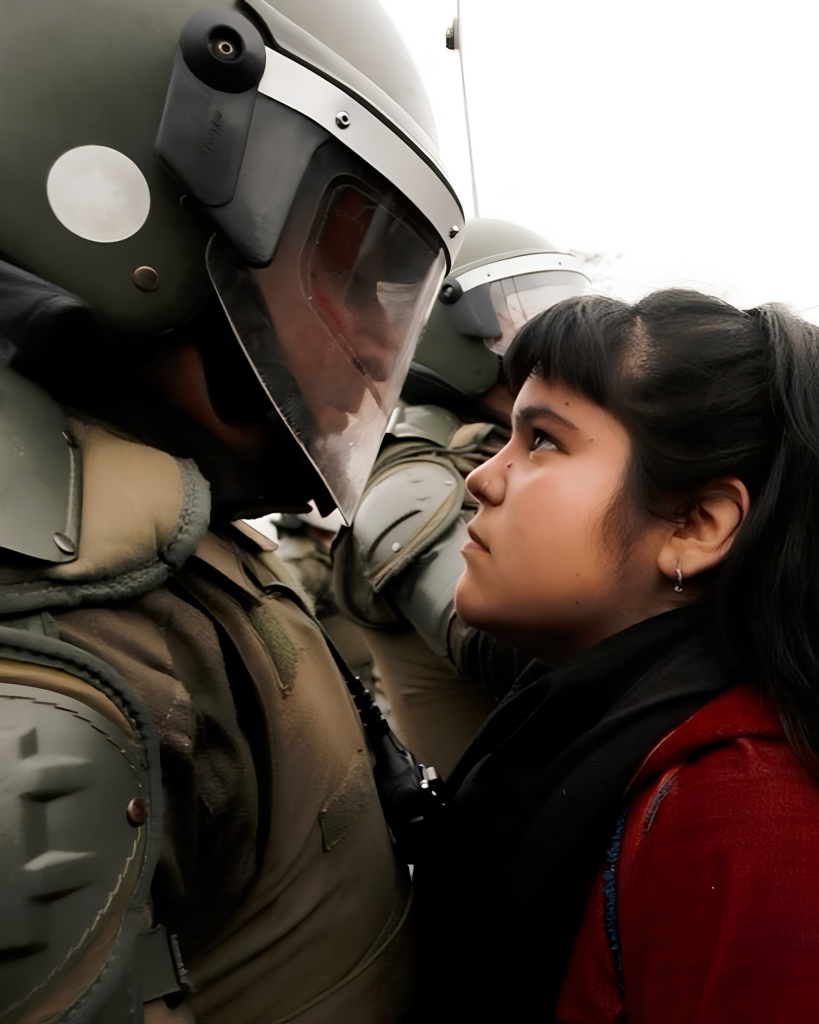

Fashion has arrived at a point where nothing feels safe, and that’s the thrill. Every collection, every runway, every campaign seems determined to push against silence. Clothes no longer hang politely on the body, they slice, they balloon, they hover between costume and sculpture. The body is no longer dressed, it is staged, it is performed, it is reimagined as something alien, divine, and confrontational.
Balenciaga has long been the shorthand for this extremity. Demna’s silhouettes have become cautionary architecture: shoulders so wide they feel like barricades, leather trenches dragging across the ground like shields, sneakers eroded to the point of apocalypse. Each garment seems to mutter, this is survival gear for the end times.
Then there is Rick Owens, fashion’s prophet of ritual. His runways are stages for resurrection, models lifted into the air like sacrifices, strapped into platform boots that tower over entire rooms, silhouettes that wrap and cocoon the body until it looks less human, more mythical. Owens isn’t designing outfits; he’s offering entry into another dimension, a place where clothing is holy text.
At the opposite pole, Loewe chooses distortion as its rebellion. Jonathan Anderson’s vision has turned everyday items into surreal relics: pixelated hoodies, balloon-shaped pumps, grass growing from sneakers, dresses painted so close to the skin they almost disappear. What could be playful becomes unsettling, because it questions reality itself. Loewe insists that fashion need not only protect or adorn, it can destabilize.
Saint Laurent sharpens everything down to a blade. Anthony Vaccarello’s recent shows are lessons in precision: the pin-sharp blazer, the severe column dress, the glossy black leather gloves that frame every gesture. This is fearlessness through discipline, through control so tight it becomes erotic. No chaos, just pure domination of form.
Diesel, under Glenn Martens, detonates denim into pure rebellion. There are jeans so shredded they barely cling to the body, leathers plastered with slogans, runway backdrops of giant inflatables that remind you the brand thrives on spectacle. Diesel is less about wearing clothes, more about weaponizing them.
And then comes Schiaparelli, a house that thrives on surreal provocation. Daniel Roseberry has turned couture into divine madness: gold-plated lungs crawling across bodices, lion heads roaring at the shoulder, eyes, ears, and lips scattered across gowns. These are not embellishments; they are confrontations. Schiaparelli dares the wearer to carry myth on their skin.
Fashion today thrives on these contradictions. Coperni crafts handbags out of glass, spraying liquid dresses directly onto Bella Hadid’s body performance as product. Prada offers nylon minimalism, sleek and clean, a reminder that restraint can speak just as loudly as excess. Thom Browne turns tailoring into absurd theatre, shrinking jackets into toys, extending trousers into floods, staging courtrooms and trains as catwalks. The extremes all coexist, each brand choosing its weapon.
What separates this moment from the past is the collapse of linearity. Trends don’t move forward neatly; they collide, cannibalize, and remix themselves. We are no longer in cycles of decades; we are in collages of centuries. Dior revisits its archive with new sharpness, Miu Miu redefines office chic by chopping skirts into belts, Balmain indulges in armor that recalls Versailles while Mugler resurrects its 90s latex with digital intensity. The past and the future are happening simultaneously.
Fearlessness is not always loud. Take The Row: its devotion to silence, to fabrics that whisper rather than scream, is its own act of defiance in a market oversaturated with spectacle. Or Bottega Veneta under Matthieu Blazy, where leather becomes jeans, skirts, even t-shirts craftsmanship so absurdly detailed it borders on magic. To present quiet mastery in a noisy world is, paradoxically, its own form of rebellion.
And perhaps it’s this hunger for rebellion that defines the era. After years of restraint, of normcore, of sweatpants culture, fashion has erupted into theatre. The Met Gala has become its altar, where a single look can dominate the internet for days, where themes like “Heavenly Bodies” or “Camp” give designers license to transcend reality. It’s no longer about elegance alone; it’s about declaring an idea that can withstand the global gaze of millions.
Digital culture only intensifies this. Every outfit is instantly global, instantly dissected, instantly judged. A runway look in Paris is a meme in Lagos within minutes. Fashion has become fearless partly because it must be, to stand out in the endless scroll, to stake a claim in a landscape where attention is currency. Brands now design with virality in mind, with spectacle that can be clipped, reposted, and immortalized.
This is why a jacket can be a dare, why a pair of boots can read like a manifesto. The runway has become a battlefield, where designers aren’t just competing for sales, but for permanence in cultural memory. The fearless aren’t afraid of ridicule, they expect it, they build for it, they use it as fuel.
So when did fashion become this fearless? Somewhere between the death of minimalism and the birth of spectacle. Somewhere between a liquid spray-on dress and a couture gown covered in gold lungs. Somewhere between a glass handbag and a nylon backpack. Somewhere between survival gear and surrealist armor.
And the truth is, fashion has no intention of retreating. It has stopped asking for permission. The only real question left is: what’s next, and who dares to go further?